Understanding your rates
Find out how your rates are calculated, what the charges and entries on your rate notice mean and why amounts may differ between properties.
How your rates are calculated
Rates are calculated based on the operating requirements of the City and each property’s valuation.
The rates you pay represent your share of the funds needed to deliver local services, facilities and infrastructure.
Your rates are calculated using:
- The rate in the dollar, set by Council as part of the annual budget
- Your property’s valuation, as assessed by the Valuer General.
The rate amount is calculated by multiplying your property’s valuation by the applicable rate in the dollar. Minimum rates may apply.
Rate in the dollar and differential rates
Each year, Council sets the rate in the dollar as part of the annual budget process.
The rate in the dollar is calculated by dividing the total funds required to deliver City services and infrastructure by the combined valuation of all rateable properties.
Different rates in the dollar are then applied to different categories of land. These are known as differential rates and recognise differences in land use, such as residential, vacant and commercial properties.
For the 2026/27 financial year, the adopted differential rates and minimum rates are shown below.
| Rating Category |
Rate in Dollar |
Minimum Rates |
| Residential |
0.06477315 |
$1,685.55 |
| Vacant |
0.12900000 |
$1,794.97 |
| Other |
0.07146508 |
$1,700.00 |
| Short-term rental Accommodation |
0.07772778 |
$1,850.00 |
Minimum rates apply where the amount calculated using the valuation and rate in the dollar is less than the minimum amount set for that rating category.
A statement outlining the City’s objects and reasons for the differential rates and minimum payments is available below.
Objects and Reasons for the 2026/27 Differential Rates & Minimum Payments
Property valuations
Most properties in the City of Vincent are rated using Gross Rental Value (GRV).
GRV is the estimated yearly rental income a property could earn if it were rented. It is assessed by the Valuer General’s Office under the Valuation of Land Act 1978.
GRV is influenced by factors such as:
- Size and age of the property
- Construction and improvements
- Number of rooms
- Features such as garages, carports and swimming pools.
Properties do not need to be rented for a GRV to be applied.
To help you further understand GRV watch this video.
Valuation cycles
The Valuer General conducts a General Valuation every three years.
Valuations reflect property market conditions at a specific point in time, known as the Date of Valuation, to ensure consistency and fairness.
The current General Valuation took effect on 1 July 2026.
How to read your rate notice
The example below shows a typical rate notice. The numbered sections explain what each part of the notice means.
Note: Some rate notices may include additional charges that do not appear on all notices. These can include charges such as the Underground Power Service Charge, where applicable. Details about these charges are explained below on this page.
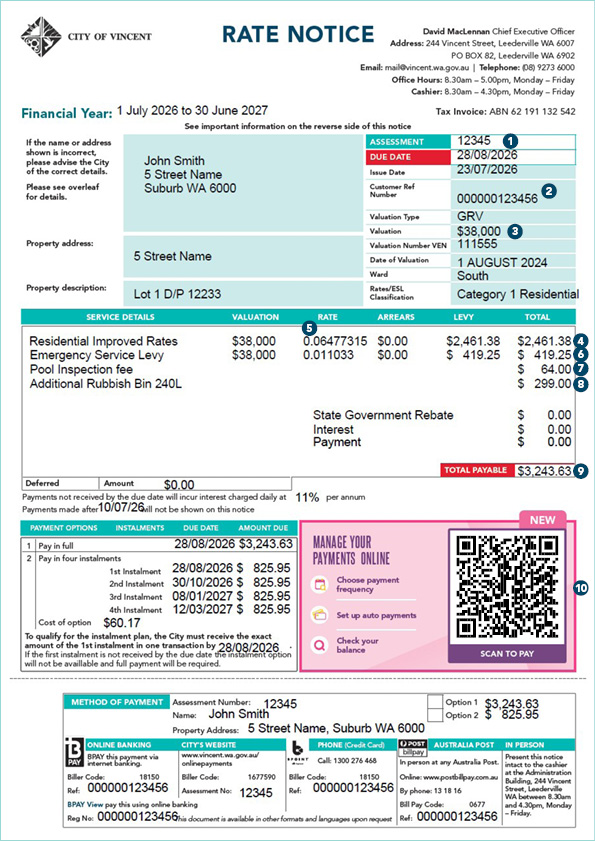
 |
Your property assessment number
A unique number that identifies a rateable property. It can be used to pay rates on the City’s website or register for e-rates.
|
 |
Customer Reference Number (CRN)
A unique number linked to your assessment and required when making a payment.
|
 |
Gross Rental Valuation (GRV)
The valuation determined by the Valuer General’s Office and used to calculate rates and the Emergency Services Levy (ESL).
|
 |
How your rates are calculated
Your rates are calculated by multiplying the applicable rate in the dollar by the Gross Rental Valuation (GRV).
|
 |
Rate
The rate in the dollar and fees and charges adopted by Council.
|
 |
Emergency Services Levy
A State Government charge that applies to all properties in Western Australia and is collected by the City on behalf of the Department of Fire and Emergency Services.
|
 |
Pool inspection fee
An annual fee applied to properties with a swimming pool, spa or pond, in accordance with the Building Act 2011 and Building Regulations 2012.
|
 |
Additional charges
Any additional property-specific charges will be listed here.
|
 |
Total rates, fees and charges
The total amount payable, made up of all individual rates, fees and charges.
|
 |
Payment options
The payment options available for your rates, including paying in full, by instalments or by flexible rates smoothing payments.
|
Changes you may see on your rate notice
In addition to general rates, your rate notice may include other charges depending on your property and circumstances.
Interim rate notices
Some ratepayers may receive an Interim Rate Notice during the year if the Valuer General reassesses a property’s valuation.
Common reasons include:
- Creation of a new property through subdivision, amalgamation or strata
- Construction, demolition or major alterations
- Installation or removal of structures such as swimming pools
- Changes affecting the use of the property
An Interim Rate Notice shows the updated valuation, the reason for the change and the effective date.
Supplementary valuations
A supplementary valuation may be issued where:
- The physical characteristics of a property change
- The use of the property changes
- The property becomes non-rateable under section 6.26 of the Local Government Act
Interest, objections and corrections
Penalty interest
Interest may be charged on unpaid rates to ensure ratepayers who pay by the due date are not disadvantaged.
Interest is applied to overdue amounts in line with the Local Government Act 1995 and Financial Management Regulations.
The current maximum interest rate is 11% per annum, calculated daily.
Objecting to rates or valuations
You may object to your rates if:
- You are not the ratepayer of the land, or
- The land is non-rateable under section 6.26 of the Local Government Act
Section 6.81 of the Local Government Act 1995 requires rates to be paid by the due date regardless of any objection or appeal. Adjustments will be made where an objection is upheld.
Rate Record – Section 6.76 of the Local Government Act 1995 outlines the process for objections to the Rate Record. Objections must be lodged in writing within 42 days of the issue date of the rate notice by email to [email protected] or by mail to City of Vincent, PO Box 82, Leederville WA 6902.
You may also object to your property’s valuation through the Valuer General under the Valuation of Land Act 1978.
The Valuation of Land Act 1978 (as amended) Part IV outlines how valuation objections may be lodged. Property owners may lodge a property valuation objection within 60 days of the issue date of the rate notice. For information on how to lodge an objection and how your property valuation is calculated, visit the Landgate website or call Landgate Customer Service on (08) 9273 7373.