sort your waste
Learn how to sort your waste correctly using the City of Vincent’s three-bin system, including what goes in each bin, what does not go in each bin and where to dispose of tricky items.
Sorting your waste correctly helps reduce contamination, recover more resources and reduce how much waste ends up in landfill.
About our bin system
Households in the City of Vincent use a three-bin system for kerbside waste and recycling.
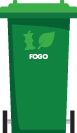
- Food and garden organics (FOGO) bin with a lime-green lid, collected weekly.
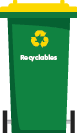
- Recycling bin with a yellow lid, collected fortnightly.
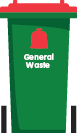
- General waste bin with a red lid, collected fortnightly.
The sections below explain what goes in each bin and what does not go in each bin.
If you are unsure about a specific item, you can also use the Recycle Right® A–Z guide.
What goes in each bin
Lime-green lid FOGO bin
Collected weekly. For food organics and garden organics only. The contents are turned into compost. Only use certified compostable liners in your kitchen caddy.
What you can put in this bin:
|
Food scraps:
- Fruit and vegetables
- Meat and bones
- Loose tea leaves and coffee grinds
- Bread and dairy products
- Seafood including shells
- Food leftovers and scraps
- Egg shells
- Out-of-date food (unpackaged)
|
Garden organics:
- Lawn clippings
- Leaves
- Flowers and weeds
- Small branches
- Twigs
|
Yellow lid recycling bin
Collected fortnightly. For recyclable materials that are sorted at a recycling facility. Items should be placed loose, rinsed and with lids off (lids must be placed in general waste). Do not bag recyclables.
What you can put in this bin:
Five items only.
- Paper (clean and dry, no shredded paper or tissues).
- Cardboard (flattened).
- Aluminium and steel cans.
- Plastic bottles and containers.
- Glass bottles and jars.
Red lid general waste bin
Collected fortnightly. For items that can’t be reused, recycled or composted.
What you can put in this bin:
- Nappies and hygiene products
- Soft plastics and scrunchable plastics
- Polystyrene and foam
- Tea bags
- Unusable clothing and rags
- Long-life liquid cartons (for example tetrapak)
- Meat trays
- Greaseproof, baking and waxed paper
- Shredded paper
- Plastic strapping
- Paper towels and tissues
- Disposable coffee cups
- Animal droppings and kitty litter
- General rubbish items
Test your knowledge with our Everyday Zero Waste Sorting Game
You will have 60 seconds to sort as many waste items as possible into their correct disposal streams. Get started below.
Using your FOGO kitchen caddy
As part of the three-bin FOGO system, households are supplied with a kitchen caddy. This small benchtop container is used to collect food scraps in the kitchen before they are placed in the lime-green lid FOGO bin.
You can use the caddy for food scraps such as leftovers, bones, tea leaves, coffee grounds and unpackaged out-of-date food.
Caddy liners
Households can collect two free packs of certified compostable caddy liners by bringing proof of address to the City of Vincent Administration Building at 244 Vincent Street, Leederville.
If you purchase your own liners, look for Australian Standard compostable symbols such as AS 5810 and AS 4736 to ensure they contain no plastic. We strongly recommend using the City provided liners to ensure you have the correct bags.
Commonly confused items
Soft plastic
Soft plastics do not go in the recycling bin. Soft, scrunchable plastics can get tangled in machinery and contaminate the paper stream.
Place soft plastics in your red lid general waste bin.
Meat trays
All meat trays must be placed in the red lid general waste bin. This is due to contamination from food residue and absorption pads, and the mix of materials used to make trays.
Consider buying meat from a butcher using paper wrap or bringing your own reusable container.
Polystyrene
Polystyrene cannot be recycled through kerbside recycling.
Small amounts can be placed in your red lid general waste bin.
Expanded polystyrene packaging can be recycled in larger amounts by dropping it at approved waste disposal centre. All pieces must have tape and stickers removed.
Coffee cups
Take-away coffee cups and lids, including compostable cups, cannot be recycled or placed in the FOGO bin.
Place all single-use coffee cups and lids in your red lid general waste bin, or a general waste street bin when you are out.
Pizza boxes
Pizza boxes that are clean and dry are recyclable and should go in your yellow kerbside bin. Pizza boxes that are greasy, food-soiled, or oily bottoms should be placed in the general waste bin to avoid contaminating recycling batches. Pizza boxes should be folded before placing in the bin.
Aerosol cans
Aerosol cans are hazardous and must not be placed in any kerbside bin. They contain pressurised, flammable gases or liquids, which can cause fires and explosions at recycling facilities or in collection trucks.
Take aerosol cans to an approved waste disposal centre.
Items that do not go in any bins
Do not place the following items in your kerbside bins:
- Household hazardous waste, including chemicals, aerosols, gas bottles, flammable liquids, pool chlorine and pesticides
- Construction and demolition materials, including bricks, concrete, soil, rubble and tiles
- E-waste, including TVs, computers, laptops, phones and printers
- Batteries, mobile phones, printer cartridges and light globes
- Large logs, stumps and oversized branches
- Medical sharps and clinical waste
- Asbestos.
- Mattresses
- Tyres
- Hot ashes or coals
To find out where to take these items, refer to the following pages:
Ways to minimise waste
The best way to manage waste is to avoid creating it in the first place.
Use this order of actions where you can:
| Avoid |
Avoid single use items. Swap for reusable shopping and produce bags, coffee cups and refill containers. Opt for unpackaged fruit and veg. |
| Reduce |
Reduce by buying only what you need. Try hire or borrow options before purchasing. |
| Reuse |
Reuse what you have. Buy or sell second-hand, join your local Buy Nothing group, visit a Repair Cafe to fix an item. Try your hand at upcycling. |
| Recycle |
Recycle items back to raw materials and into new products. Take hazardous items or electronic waste to recycling drop-off points. |
| Recover |
Recovery converts some residual waste into energy, with some metals and minerals recoverable. |
| Dispose |
Dispose to landfill as the last resort. |
There are also many ways to minimise waste in Vincent, including:
- Buy Nothing Groups
- Repair Cafe Perth
- Waste education workshops.
You can also explore the City's rebates, programs and initiatives such as reusable sanitary products, modern cloth nappies and other waste minimisation options.
Containers for change
Containers for Change is Western Australia’s container deposit scheme. Eligible drink containers with a 10c refund mark can be returned to a refund point to be recycled, helping keep valuable materials out of landfill.
Getting involved is easy. Simply collect your eligible containers and return them to a Containers for Change refund point. You can keep the refund, donate it, or use it to support a school, club or charity.
Look out for container exchange points, such as baskets or cradles attached to public bins in some parks and town centres. These allow containers to be collected and returned for recycling by others.
Find your nearest refund point and learn more on the Containers for Change website.
How to sort your waste guide (in different languages)
The City has developed a How to Sort Your Waste guide that can be printed for easy reference.
The guide is available in several languages: